Tuesday, March 16, 2010

A Poem about TWO Cats!


Any poem with "cats" in the title is sure to attract Ana. Here's a poem about not one, but two cats, which she couldn't wait to read.

Once again, she needed Matt to explain terms like "Florentine bravoes," and "stiletto," but after they read it several times out loud to each other, she decided she liked it even though she found fault with parts of it.

Those who know Ana through her stories know that she and cats seem to be on the same wavelength. Most cats are quite fond of her, and she reciprocates that affection. As for cats' relations with each other, they are tribal, she feels. Just as lions congregate in a pride, with one male and several females and cubs, so will domestic cats under normal circumstances. It's not that they're indifferent to each other, but that they observe tribal boundaries.

At the same time, she agrees that cats do indeed do things with the least possible fuss. What she likes most of all about the poem is that it accurately describes the way cats accept their situations stoically. Dogs do that too, in her experience. She finds that admirable, even while she knows full well that accepting the status quo is something that humans should not do too much of. So much needs to be improved.

By the way, at first Matt felt weird reading poetry to his wife, and having her read it to him. It took him back to elementary school. Ana changed his mind about that. She takes such delight in verbal performance that he began to enjoy it as well. Even their children join in sometimes. Try it yourself, with friends and loved ones! You might like it!

"Two Cats," by Katha Politt
NOTE: This host site has been closed, but the workaround often does the trick. Please see my Apology. Thanks!

Also: Learning Peace from a Cat

Many more poems, including cat poems, are in the right column under the photo of the LOVE sculpture.

Thursday, March 11, 2010

Ana's Native Language, Luvit, Examined


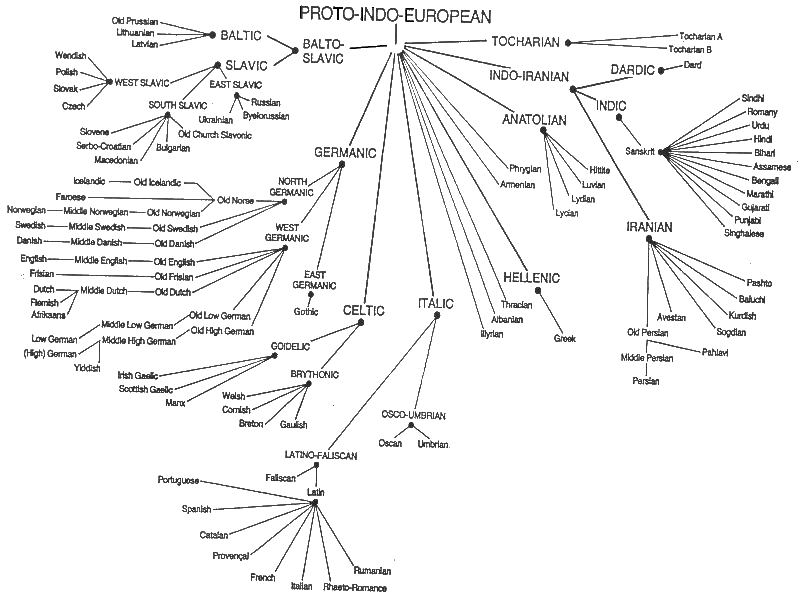
(The graphic above (with thanks to Bucknell University) is discussed below. If you right click it and open it in another tab, it will be conveniently available.)

The language of Ana's people on their home planet, Thomo, was touched on briefly in Distant Cousin, chapter 20, when Ana first met Dr.William Sledd, a philologist and linguist. Perhaps this is the place to delve a bit more into the history of her language and her people. We'll get to what clues from her language electrified Dr. Sledd below.

As you may have read in her responses to reader questions (Question 4), Ana's ancestors had been transplanted to Thomo some 162 generations ago. Using the standard Earth figure for one generation, 20 years (the typical time for an infant to grow to adulthood and have children), we can calculate that her people were removed from Earth approximately 3260 years before the present era, give or take. We also learn, in DC3, Distant Cousin: Reincarnation, that she seems to have some mysterious ties to the people of the Caucasus, near the Black Sea, on the dividing line between Europe and Asia.

That region is thought to have been the homeland of the Proto-Indo-European tribes from which today's Indo-European languages sprang. Three thousand years is a long time, and the nomadic peoples who lived in that area left almost nothing of themselves behind. The detective work which points to them as the original speakers of Indo-European has been almost entirely linguistic in nature, based on examination of similarities and differences between their modern descendant languages. (This was touched on in Distant Cousin, Book 2, chapter 18.) Volumes have been written about this scholarly detective work, but the details are far beyond what can be covered here.

Suffice it to say that over many centuries, tribes of nomadic Indo-Europeans wandered far from home, never to return. Some went as far as present-day India. Others stopped in Iran and Afganistan. Still others went to Scandanavia, and throughout Europe. As they settled and multiplied in their new areas, their language changed over time, to fit their local conditions. In brief, the result is today's collection of modern Indo-European languages, which when graphed resembles a family tree, complete with multiple branches.

The branches of this "family tree" mostly correspond to the geographical areas of the globe that the ancient wanderers settled. (See the graphic.) There is an Indian branch, for example, a Hellenic branch, an Italic branch, and Iranian, Germanic, and Balto-Slavic branches. Each one of these branches has split into numerous other languages over time.

To mention just one example, take the Italic branch. Two thousand years ago, the language of the Indo-Europeans who had settled in the Italian peninsula had slowly become Latin. Likewise, the Hellenic group was speaking classical Greek. The ancient Indo-European language in India evolved to Sanskrit, still studied today much as Latin and Greek are in the West.

Again, that was two thousand years ago, a long time. The Roman Empire spread Latin throughout Europe until it collapsed about the year 400, leaving Latin speakers largely scattered and isolated (the so-called "Dark Ages," not really all that dark). Over the following centuries their Latin changed slowly in all the places they remained, eventually becoming mutually unintelligible, in effect, different languages: French, Spanish, Italian, Portuguese, Catalan, and so forth.

Similar things happened with the Germanic branch (which evolved to German, Dutch, English, Danish, etc.), with Sanskrit (Hindi, Bengali, Kashmiri, Gujarati, etc.), and with other branches. (Refer to the graphic for a few more examples. Also note that most college desk dictionaries contain a chart of these, usually under "Indo-European Languages.") A little study of the chart will provide several insights. The parent language of modern English is Germanic. The parent language of modern Spanish is Latin. Going further back one linguistic "generation," the parent of Germanic and Latin is Proto-Indo-European. In a human family tree, what do you call two indviduals who have different parents but the same grandparents? Cousins, of course. Keeping in mind that this is only a memory aide and not a statement of actual relations, one could loosely say that English and Spanish are cousin languages, as are English and Italian, English and Hindi, Russian and Swedish, English and Farsi (spoken in Iran) and so forth.

Now we are ready to go back to Dr. Sledd in his study in Alpine, Texas. Matt Mendez told him Ana's station manager was named "Hleo." Sledd showed Matt a dictionary of Ango-Saxon, the language of Beowulf: "hleo" is the Old English word for "shelter," "protector," which suggested to him that her language fell under the Germanic group. Then, later, when Sledd finally met Ana, he learned her last name was "Darshiell," which she said meant "from the rainbow." A modern language with a similar word is French: "d'arciel," also meaning "from the rainbow." This was what astounded him: French comes under the Italic branch, entirely different from the Germanic. Based on only these two words, he had a piece of evidence that her language was related to TWO major branches of the Indo-European family tree--Germanic and Italic. This suggested to him that her language dated from before the time those two groups split apart--which would be very early indeed.

Note that the graphic shows two branches which have no descendants: Albanian and Armenian. Dr. Sledd and his linguistic collaborators have posited, in the monograph they published after working with Ana for a while, that Luvit is another such branch!

The name her people gave their planet, for example, is "Thomo." In Luvit, that "th" has a soft sound, rather like a "d," almost like "domo." It's an obvious cognate with English "domicile," and "domestic." The root word is found in Latin (because Engish borrowed it from Latin, along with thousands of other words, after the Renaissance). It means "home." Thus Luvit has affinities to the Latin branch. But readers who are familiar with the Slavic languages--Czech, Polish, Russian--may recognize some of the other Luvit phrases Ana uses from time to time, which reveal ties to the Slavic branch. Ana's language will never be a major feature of her stories, but anyone who wishes to pursue the matter might start with the Wikepedia article on the roots of Proto-Indo-European.

Sunday, March 7, 2010

Poem: What She Taught Me


Here's a poem about someone remembering a teacher, an elementary teacher, apparently. Ana loves, loves, loves this one. It took her a session with Matt, reading it together, to fully understand it. She wasn't up on "linking verbs" or "predicate nouns," she knew none of the songs (but she does now), and she had never heard the word "goober" used to refer to peanuts. (Her son occasionally uses it to address his sister--that's the "goober" she was familiar with.) Once those details became clear she loved the collection of child-like memories.

She picked up on the change of tone at the end right away, although Matt had to help her with the meaning of "a man of a different stripe." She liked the idea that the speaker, despite being looked down on by her community nevertheless carries on regardless, because that's what courageous people do--on her world as well as ours.

It might be interesting to ask Ana what similar things she remembers about a teacher of hers.

Once again, we cannot reproduce copyrighted work. If you'll right click the link and open in another tab, you can easily return!

"What She Taught Me," by Marjorie Saiser (Oops: target page taken down; please see Workaround. It works!)

See more of Ana's favorite poems in the right column under the photo of the LOVE sculpture-->

Thursday, March 4, 2010

Measure Twice, Cut Once: a Poem about Carpentry


Why would an extraterrestrial woman be attracted to a poem about carpentry?

Ana's attention was caught by this poem because she had just spent part of the afternoon watching Matt rebuild a door frame in the old part of their house and then rehang the door.

He began after breakfast one morning, and didn't finish putting away his tools until the middle of the afternoon. The door frame was solid, though, and even matched the other ones in the house, and the door swung smoothly and closed tightly.

Ana, who tends to do things quickly, at first wondered why he was taking so long, but she soon realized he was thinking before doing, and making sure each step was done correctly. She often remembered that day with pleasure, especially when she opened or closed that door.

If you think about it, "Putting in a Window," by John Brantingham, is practically a love poem.

[NOTE: the linked page has been taken down. To search out this poem, please see the workaround. Thanks!]

See more of Ana's favorite poems in the right column under the photo of the LOVE sculpture-->

Monday, March 1, 2010

Another big cat: A Lynx, this time


If Ana's family were serious about collecting cats, perhaps they should consider a lynx. Julie, of Julie's Jungle, says this lynx is one of the sweetest, most gentle and loving cats she has. Look at the paws on her! Lynxes figured in Distant Cousin: Reincarnation, but they were of the Eurasian species. There's a photo of one of those in the right column, third from the bottom. They probably aren't as sweet as this one. Thanks, Julie!

See many, many cat photos in the right column under the photo of the blue-eyed kitty-->

Friday, February 26, 2010

Distant Cousin Touches Another Soul: True Story


A blog came to our attention recently, a blog by a gentleman with serious health problems, whose only choice is to contemplate final things and his relation to them.

Imagine--if you can--the exhilaration of a person who overcomes a potentially deadly disease, alcoholism, through a supreme effort of will. Then, after that life-affirming triumph, imagine being diagnosed with Alzheimer's disease. Such a cruel twist of fate would be incomprehensible to most of us. This particular man, however, has courageously devoted himself to attempting to reconcile his plight by seeking to understand his position with respect to eternity, by studying religion, the philosophy of Buddha, and more. In his blog he says he has finally succeeded--with the assistance, incredibly enough, of a bit of philosophy from Ana Darcy.
In his blog, he makes this statement: "My western trained mind continues asking, 'But where is God?' My Catholic mind keeps looking for the Last Four Things! ...I let this question go unanswered until I came across a statement of God that gave sense to the definition lurking within me." He then cites a passage from Distant Cousin: Repatriation, the second volume of the series (slight spoiler alert). In the passage, Ana is in the clutches of a kidnapper, and her situation is deteriorating ominously. This is the actual dialog:

"Do you believe in God, Ms. Darcy?"
"Do I believe in God?"
"Yeah."
"Do you mean an an...anthropomorphic God or a transcendent God?"
"A what?"
"Do you mean, do I believe in a God who's like us, but maybe with a beard, or some kind of more abstract, spiritual entity?"
"Either one."
"Well, I don't think I believe in an anthropomorphic God who lives up in heaven, like some people do. But it would be hard to travel as far across the universe as I have without considering where it all came from. I suppose I believe in God as an algorithm."
"A what?"
"An algorithm. A system of formulas or laws, like in physics, that explain how things have come to be."
"Yeah?"
"I think so. Yes."
"Interesting...not a lot of comfort in that, though, is there?"
"Comfort? I don't know. Maybe there is, some. It suggests, to me, anyway, that all we have for comfort lies in each other, in ourselves. Whatever God is, we need to care for each other. I try to do that myself. Why did you ask me about God?"
"Oh, just curious. Never mind."

In an email message, the gentleman, Mike Donohue, explained: "I am aged 73, on the down hill slide. Do not be sorry about my affliction. Even though it has me sliding it has forced such opportunity on me to get everything in my wavering brain expressed in writing or in digital art. 43 years I was a successful trial lawyer traveling throughout the country handling cases. That is small potatoes to where Alzheimer's disease has now placed me. Now I am totally involved with who I am, have always been but could not see it until all the glitter was removed. This parting segment of life is just not all that bad.
"I am enjoying it, sharing it and having some sense of doing good with it. Like Ana I have an Algorithm working full bore in me.... I work feverishly at getting it all done before my mind beats me to it. This provides me a pretty satisfying life in race with the demons."

Mr. Donohue, racing those demons, is an inspiration. If we were ever to be in a similar situation, we can only pray we could face it with such resolution and grace. We are humbled and pleased that Ana Darcy's message has provided Mr. Donohue some comfort. We wish him well.

You will be always in our thoughts, sir.

Mr. Donohue's blog may be found here. His insight is here (near the bottom, just above the red graphic). He has written the account of his quest into a book, From AA to AD, A Wistful Travelogue, here.

Sunday, February 21, 2010

The Music of the Galaxy?


Ana loves most kinds of our music, but she really, really loves the music of Bach. One of her all-time favorites is Bach's Prelude #2 in C minor (BWV 847) from the Well Tempered Clavier. Ana said that if you could lift the hood of the universe and listen to the engine running, it would sound just like this famous piece (and she should know, having traveled through a good part of it).

Ana learned to play that prelude, but not as well as she would like. Her favorite recorded version is by the well-known Brooklyn harpsichordist Rebecca Pechefsky. Ms. Pechefsky, who has actually met Ana Darcy, graciously allowed us to present it to Ana's fans.

Ana loves the sparkly, resonant, brilliant sound of the instrument. Most people, particularly piano students, are familiar with the Well Tempered Clavier on the piano. If you are one of those, you owe it to yourself to hear it on the same kind of instrument for which Bach composed it. It's stunning.

You may hear Sviatoslav Richter playing that prelude here. (If you right click and open in another tab, you may listen while you continue your visit to Ana's site.)

If you would like your own copy of Ms. Pechefsky's splendid, benchmark recording of the complete Book 1 of the Well Tempered Clavier, you may find it here, or here at Amazon, where you can sample all 24 tracks! Ana also loves the Fugue in c minor which follows the Prelude (track 4).

To hear the theme song of the Distant Cousin books, another piece that Ana loves, slightly more mellow and reflective, played on the theorbo, click here.