Showing posts with label Luvit. Show all posts

Friday, August 26, 2011

Ana gives us some Luvit proverbs from the planet Thomo!


Ana Darcy's native language, Luvit, is spoken by the people of the planet Thomo. (The photo above represents Thomo and its two moons.) There are a number of Luvit words scattered throughout the various Distant Cousin books, but there is no point in providing more than a few, because Luvit is almost completely unintelligible to us. (There is, on the other hand, a fair amount of Spanish in the books, and not all of that needs to be translated. There is also a bit of French, in the first volume.)

We know, however, that Luvit is related to English, Spanish, and French, and to all the Indo-European languages generally. It was, in fact, one of the first languages to split off from the original, long-lost Proto Indo-European of some thousands of years ago. This knowledge comes to us from Dr. William Sledd, a linguist and philologist, as a result of his studies with the assistance of Ana in volume 1. A more complete account of what he discovered is found elsewhere on this blog.

A number of readers have asked for more samples of Luvit, however, and because the various posts of Spanish proverbs on this blog have been popular, we asked Ana if she would provide us a few proverbs in Luvit. We felt sure there would be proverbs in Luvit, and there are. She graciously assented, and they are listed below. Thoman proverbs are as colorful as Earthly proverbs!

Some preliminary notes:

1. The Thoman writing system is as unintelligible to us as the spoken language. While the International Phonetic Alphabet can precisely indicate the sounds of all languages through the use of an elaborate system of symbols, that too is difficult to decipher by all but practiced linguists. Accordingly, we will render the proverbs as closely as we can using standard English orthography.

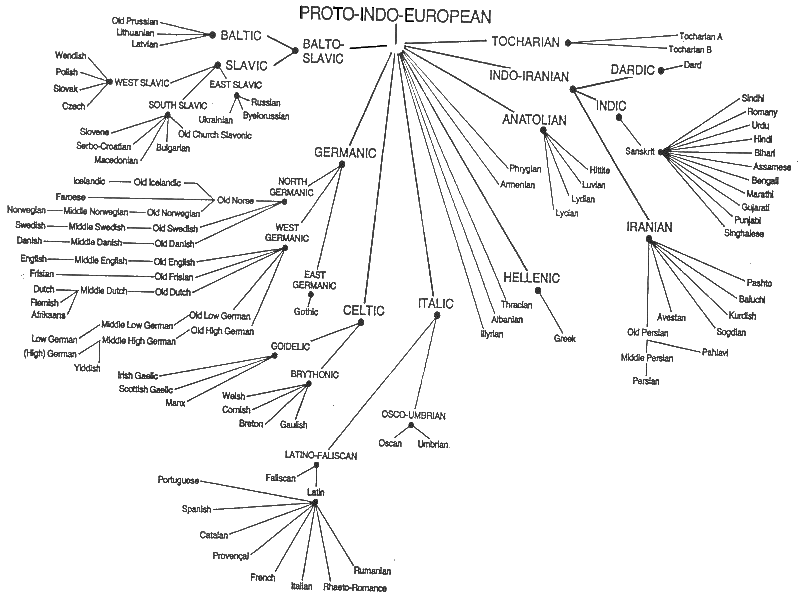
2. Ana's editor, your humble servant, happens to be a practiced linguist, and while not terribly familiar with Luvit, we will attempt to point out, in notes which follow, a few words which may show possible connections between three of the great families of Indo-European languages: Germanic, Balto-Slavic, and Italic. (See a chart of the branches here.)

3. You might be surprised, after looking over what seem to be harsh sounding words below, to hear spoken Luvit. It is generally rather soft and smooth sounding.


The Proverbs

1. pez bra:sh nyesu kola:sh

      Without work, there are no cakes.


2. pez bensh, do hoshpodzh nelesh.

      Don't go to the pub without money.


3. neilepsh kuchakh ye hlad.

      Hunger is the best cook.


4. vnochi cherna: kazht

      Every cat is black at night.


And a nonsense tongue twister, with NO vowels:

5. strsh prsht skrz khrk

      Stick a finger through your throat.


NOTES:

1. "Pez," in proverbs 1 and 2, would seem to mean "without." "Bensh," in #2 reminds us of "pence."

2. The symbol "a:" indicates a low central vowel, like the vowel sound in "thought."

3. In proverb #1, "kola:sh" probably means "cake," and might be related to Czech and Polish (and English, for that matter) "kolace."

4. In proverb #3, "kuchakh" must mean "cook." German is "koch." English has "cook" and "kitchen," of course.

5. In proverb #4, "vnochi" probably means "night" or "at night," and might be similar to Spanish "noche," French "nuit," and Italian "notte," not to mention Latin "nox, noctis." Also, "cherna:," "black," might be related to "czerny," "black" in Polish. And perhaps "kazht" is similar to "cat" or German "katte," or even Spanish "gato."

6. For tongue twister #5, we have only one comment: if you say, carefully, "shtrk," you can say a "word" with no vowels. A linguist would say it has a "semi-vowel," that is, a way to slide from one consonant to the next. Apparently, that's all that's needed for a few select words.


Thanks, Ana!


Mexican-American proverbs: One  Two Three

Spanish nursery rhymes: One  Two

Wednesday, March 16, 2011

A Poem About Gravity, and Some Heavy Thoughts


Ana Darcy Méndez, the extraterrestrial woman who came to earth from her planet thanks to the power of gravity, was delighted to find a poem about gravity, and the center thereof. She loved discussing it with her husband. Matt had to show her what a "military Jeep" was (which the poem points out had a high center of gravity), and he had to sketch a picture of an ottoman (which has a low center of gravity). Neither knew that "gravidanza" was the Italian word for pregnancy. Ana was amused by that, and also by the Spanish word for the same condition, "embarazada," which erroneously suggests "embarrassed" to an English speaker.


She was also intrigued by the connotations "gravity" has for human behavior--the absence of which, in a person, the poet calls "flightiness." These connotations are not present in Luvit, her native language, and discussing them constituted a mini-lesson in some of the fine points of English, yet another reason she enjoys poetry.

Earth astronomers, but far fewer of the general population, understand that the original elements of the universe were only three or so of the lighter ones. The more than a hundred heavier elements were generated in the furnaces of the stars, after the big bang. We humans, along with most of the Earth, including the animals and plants, are composed of these star-generated elements. Our elements are eternal: we are literally made of "star stuff," and our elements will be recycled, along with our planet, our sun, and our universe, in the immeasurable course of celestial time. Ana's people not only know this, they celebrate it. The Thoman epic poem about Ana, The Eternal Circle, exalts this process.

That's why Ana liked the conclusion of the poem, the notion that people should have a "center of gravity." She agrees with the poet that the end of life is the "most perfect center of gravity ever."

 The Center of Gravity. by Ron Padgett*
Target page taken down. Please see the workaround!


(See more of Ana's favorite poems in the column on the right, under the LOVE sculpture.)


Thursday, March 11, 2010

Ana's Native Language, Luvit, Examined


(The graphic above (with thanks to Bucknell University) is discussed below. If you right click it and open it in another tab, it will be conveniently available.)

The language of Ana's people on their home planet, Thomo, was touched on briefly in Distant Cousin, chapter 20, when Ana first met Dr.William Sledd, a philologist and linguist. Perhaps this is the place to delve a bit more into the history of her language and her people. We'll get to what clues from her language electrified Dr. Sledd below.

As you may have read in her responses to reader questions (Question 4), Ana's ancestors had been transplanted to Thomo some 162 generations ago. Using the standard Earth figure for one generation, 20 years (the typical time for an infant to grow to adulthood and have children), we can calculate that her people were removed from Earth approximately 3260 years before the present era, give or take. We also learn, in DC3, Distant Cousin: Reincarnation, that she seems to have some mysterious ties to the people of the Caucasus, near the Black Sea, on the dividing line between Europe and Asia.

That region is thought to have been the homeland of the Proto-Indo-European tribes from which today's Indo-European languages sprang. Three thousand years is a long time, and the nomadic peoples who lived in that area left almost nothing of themselves behind. The detective work which points to them as the original speakers of Indo-European has been almost entirely linguistic in nature, based on examination of similarities and differences between their modern descendant languages. (This was touched on in Distant Cousin, Book 2, chapter 18.) Volumes have been written about this scholarly detective work, but the details are far beyond what can be covered here.

Suffice it to say that over many centuries, tribes of nomadic Indo-Europeans wandered far from home, never to return. Some went as far as present-day India. Others stopped in Iran and Afganistan. Still others went to Scandanavia, and throughout Europe. As they settled and multiplied in their new areas, their language changed over time, to fit their local conditions. In brief, the result is today's collection of modern Indo-European languages, which when graphed resembles a family tree, complete with multiple branches.

The branches of this "family tree" mostly correspond to the geographical areas of the globe that the ancient wanderers settled. (See the graphic.) There is an Indian branch, for example, a Hellenic branch, an Italic branch, and Iranian, Germanic, and Balto-Slavic branches. Each one of these branches has split into numerous other languages over time.

To mention just one example, take the Italic branch. Two thousand years ago, the language of the Indo-Europeans who had settled in the Italian peninsula had slowly become Latin. Likewise, the Hellenic group was speaking classical Greek. The ancient Indo-European language in India evolved to Sanskrit, still studied today much as Latin and Greek are in the West.

Again, that was two thousand years ago, a long time. The Roman Empire spread Latin throughout Europe until it collapsed about the year 400, leaving Latin speakers largely scattered and isolated (the so-called "Dark Ages," not really all that dark). Over the following centuries their Latin changed slowly in all the places they remained, eventually becoming mutually unintelligible, in effect, different languages: French, Spanish, Italian, Portuguese, Catalan, and so forth.

Similar things happened with the Germanic branch (which evolved to German, Dutch, English, Danish, etc.), with Sanskrit (Hindi, Bengali, Kashmiri, Gujarati, etc.), and with other branches. (Refer to the graphic for a few more examples. Also note that most college desk dictionaries contain a chart of these, usually under "Indo-European Languages.") A little study of the chart will provide several insights. The parent language of modern English is Germanic. The parent language of modern Spanish is Latin. Going further back one linguistic "generation," the parent of Germanic and Latin is Proto-Indo-European. In a human family tree, what do you call two indviduals who have different parents but the same grandparents? Cousins, of course. Keeping in mind that this is only a memory aide and not a statement of actual relations, one could loosely say that English and Spanish are cousin languages, as are English and Italian, English and Hindi, Russian and Swedish, English and Farsi (spoken in Iran) and so forth.

Now we are ready to go back to Dr. Sledd in his study in Alpine, Texas. Matt Mendez told him Ana's station manager was named "Hleo." Sledd showed Matt a dictionary of Ango-Saxon, the language of Beowulf: "hleo" is the Old English word for "shelter," "protector," which suggested to him that her language fell under the Germanic group. Then, later, when Sledd finally met Ana, he learned her last name was "Darshiell," which she said meant "from the rainbow." A modern language with a similar word is French: "d'arciel," also meaning "from the rainbow." This was what astounded him: French comes under the Italic branch, entirely different from the Germanic. Based on only these two words, he had a piece of evidence that her language was related to TWO major branches of the Indo-European family tree--Germanic and Italic. This suggested to him that her language dated from before the time those two groups split apart--which would be very early indeed.

Note that the graphic shows two branches which have no descendants: Albanian and Armenian. Dr. Sledd and his linguistic collaborators have posited, in the monograph they published after working with Ana for a while, that Luvit is another such branch!

The name her people gave their planet, for example, is "Thomo." In Luvit, that "th" has a soft sound, rather like a "d," almost like "domo." It's an obvious cognate with English "domicile," and "domestic." The root word is found in Latin (because Engish borrowed it from Latin, along with thousands of other words, after the Renaissance). It means "home." Thus Luvit has affinities to the Latin branch. But readers who are familiar with the Slavic languages--Czech, Polish, Russian--may recognize some of the other Luvit phrases Ana uses from time to time, which reveal ties to the Slavic branch. Ana's language will never be a major feature of her stories, but anyone who wishes to pursue the matter might start with the Wikepedia article on the roots of Proto-Indo-European.